Environmentally Benign Approach to the Synthesis and Biological Evaluation of Derivatives of Pyrrolo[2,3-b]pyridine
Ranjan Kumar Singh
Department of Chemistry, Jai Prakash University, Chapra-841302 (Bihar), India.
K. P. Srivastava
*

Department of Chemistry, Jai Prakash University, Chapra-841302 (Bihar), India.
*Author to whom correspondence should be addressed.
Abstract
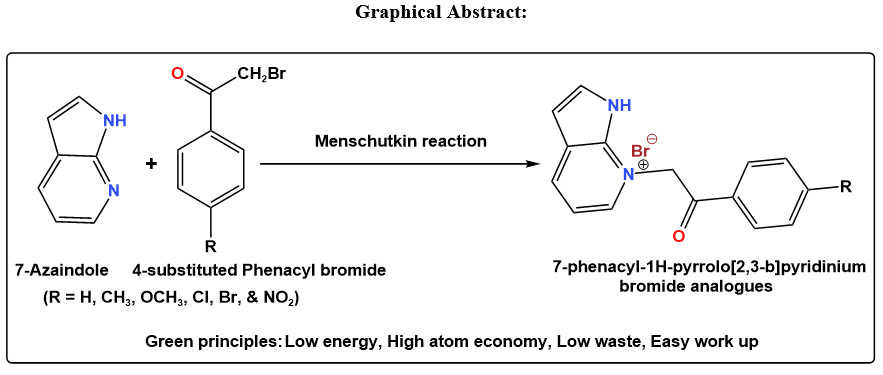
A series of novel 7-(phenacyl)-1H-pyrrolo[2,3-b]pyridinium bromide analogues was synthesised using an environmentally benign and efficient protocol. The methodology involved the direct N-alkylation of 1H-pyrrolo[2,3-b]pyridine with substituted phenacyl bromides under mild conditions via a mechanochemical procedure, as an alternative to conventional synthetic methods. The compounds were characterised by FT-IR, UV-visible spectroscopy, 1H NMR, HRMS, and elemental analysis. The biological potential of the synthesised analogues was evaluated using antimicrobial assays. The compounds exhibited poor to moderate biological activity, depending on the electronic nature of the substituents on the aromatic ring. Electron-withdrawing substituents, such as nitro, chloro, and bromo groups, enhanced biological activity relative to electron-donating substituents. The present study demonstrates an efficient green synthetic route to biologically important pyrrolopyridinium derivatives and indicates their potential as pharmacological scaffolds.
Keywords: Heterocyclic compounds, green synthesis, Pyrrolo[2,3-b]pyridine, mechanochemical procedure, antimicrobial activity